The mechanical testing room houses the lab’s primary load frames and custom devices for axial, torsional, shear, and impact loading of biological tissues, implants, and experimental constructs. Systems range from benchtop material testers to servo-hydraulic multiaxial frames and custom-built rigs designed in-house.
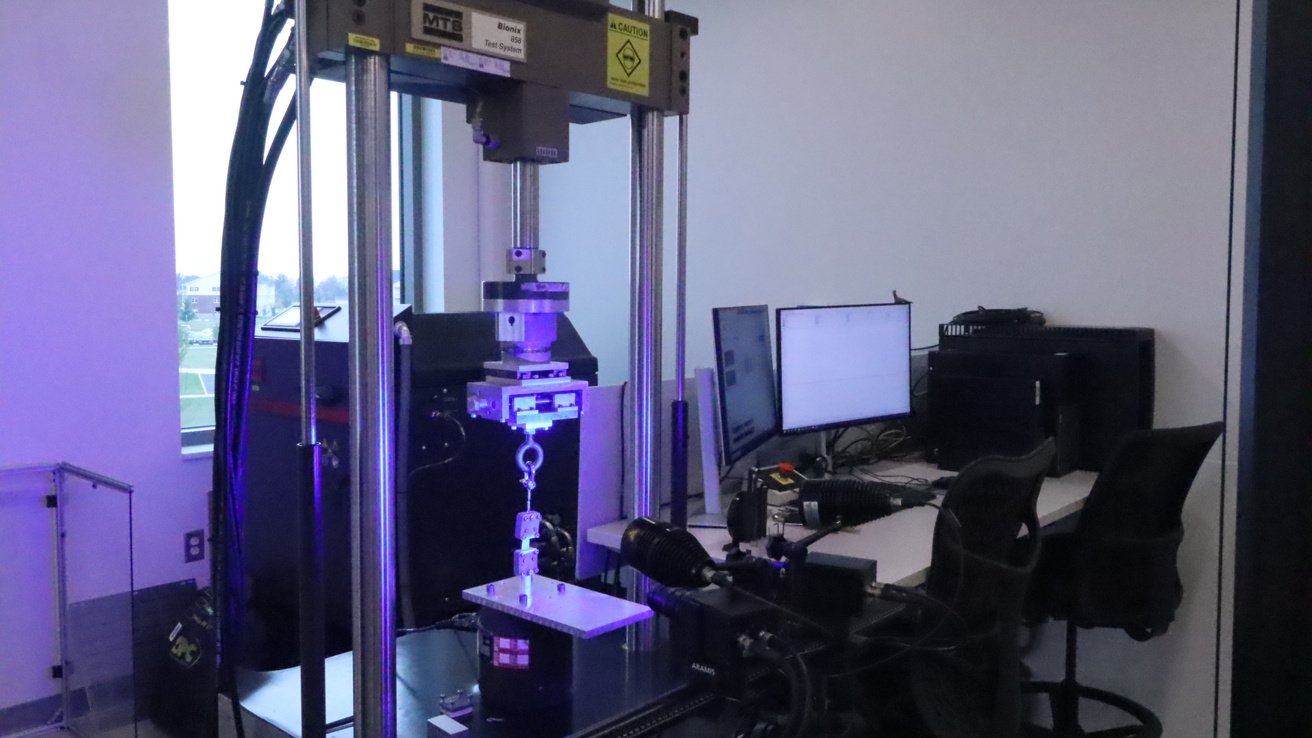
MTS Bionix 858.20 servo-hydraulic test system
Floor-standing axial/torsional load frame used for macroscopic testing of joints, tissues, and implants.
- Axial capacity: 25 kN
- Torsional capacity: 250 N·m
- Vertical test space: 789 mm (31 in)
- Stroke length: 152.4 mm (6 in)
- Rotational range: ±50°
The system is operated via MTS TestSuite® with graphical user interfaces. Users can configure custom loading protocols ranging from simple steps, ramps, and haversine waveforms to complex physiologic loading histories assembled from concatenated waveform segments. Custom fixturing can be designed and mounted to accommodate a wide range of specimen geometries.
Custom tissue loading devices
The lab maintains a family of custom-built small-scale testing and stimulation systems with lightweight aluminum frames for mechanical characterization and conditioning of biological tissues. All systems are controlled from a Windows PC using National Instruments® hardware and LabVIEW® for data acquisition and motion control, enabling custom loading and stimulation protocols.
Reconfigurable axial compression devices
- Stepper motor–driven actuators
- 50 lbf Inline tension/compression load cells
- Primary uses: repetitive compressive loading of tissues in custom chambers, or reconfiguration as portable indentation testers.
Custom indentation device
- Stepper motor–controlled X–Y positioning stage
- 10 N load cell
- 3 mm diameter cylindrical indenter tip (customizable)
- Vertical stepper-driven linear actuator
- Can be operated inside a standard tissue/cell culture incubator for testing under controlled environmental conditions
Shear loading and friction device
- Stepper motor actuator with inline 10 N load cell
- Normal loads applied via weights to vertical shaft and platen
- DVRT (differential variable reluctance transducer) for vertical displacement measurement
- Used to quantify shear behavior and frictional properties of tissue with custom holders and chambers.
Tissue impact devices
- Electronically controlled drop tower impactor with accelerometer, load cell, and high-speed laser displacement sensor for detailed impact characterization.
- Matching manual (non-encoded) drop tower with identical geometry and mass distribution for experiments not requiring full instrumentation.
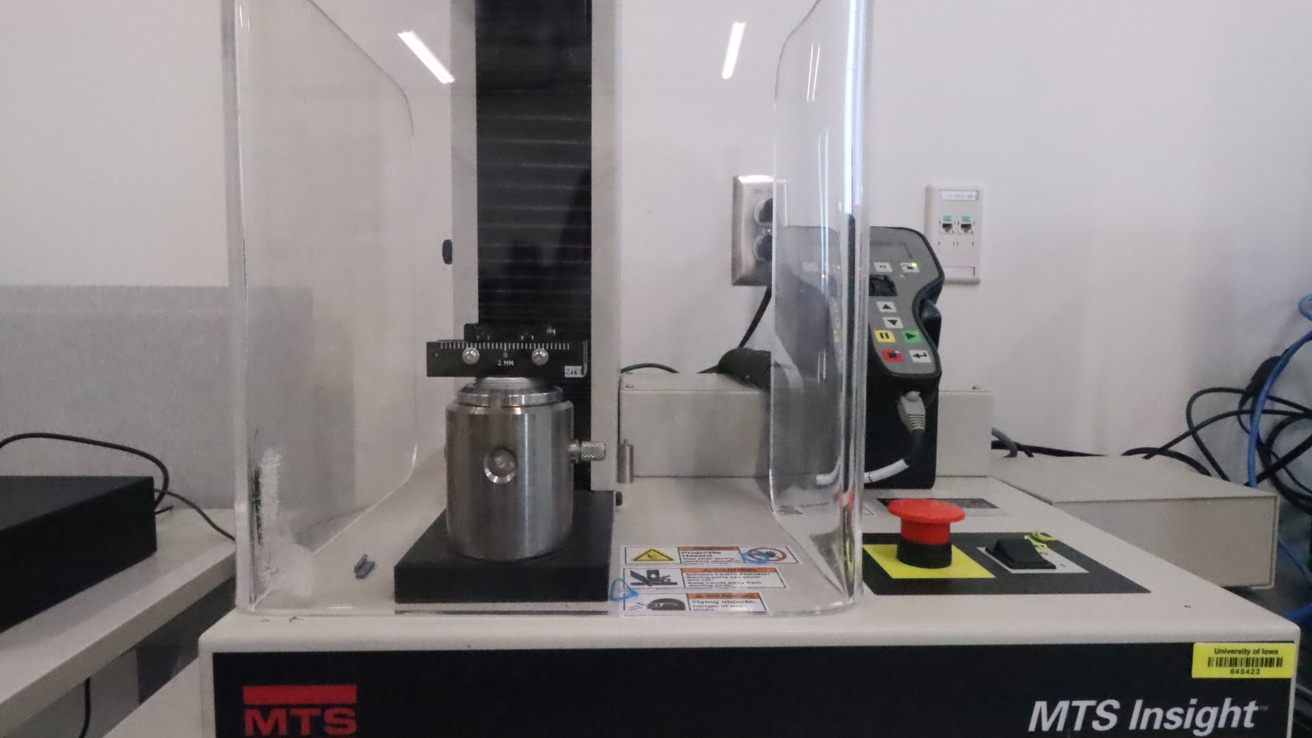
MTS Insight
Desktop, single-column axial test frame for tension and compression testing of smaller specimens and components.
- Force capacity: 1 kN (≈225 lbf)
- Maximum stroke: 750 mm (30 in)
A variety of grips and fixtures are available, and additional custom fixtures can be fabricated to integrate with the frame. The system is also operated via MTS TestSuite® software, allowing consistent test definition and data output across both MTS platforms.
ARAMIS Digital Image Correlation System
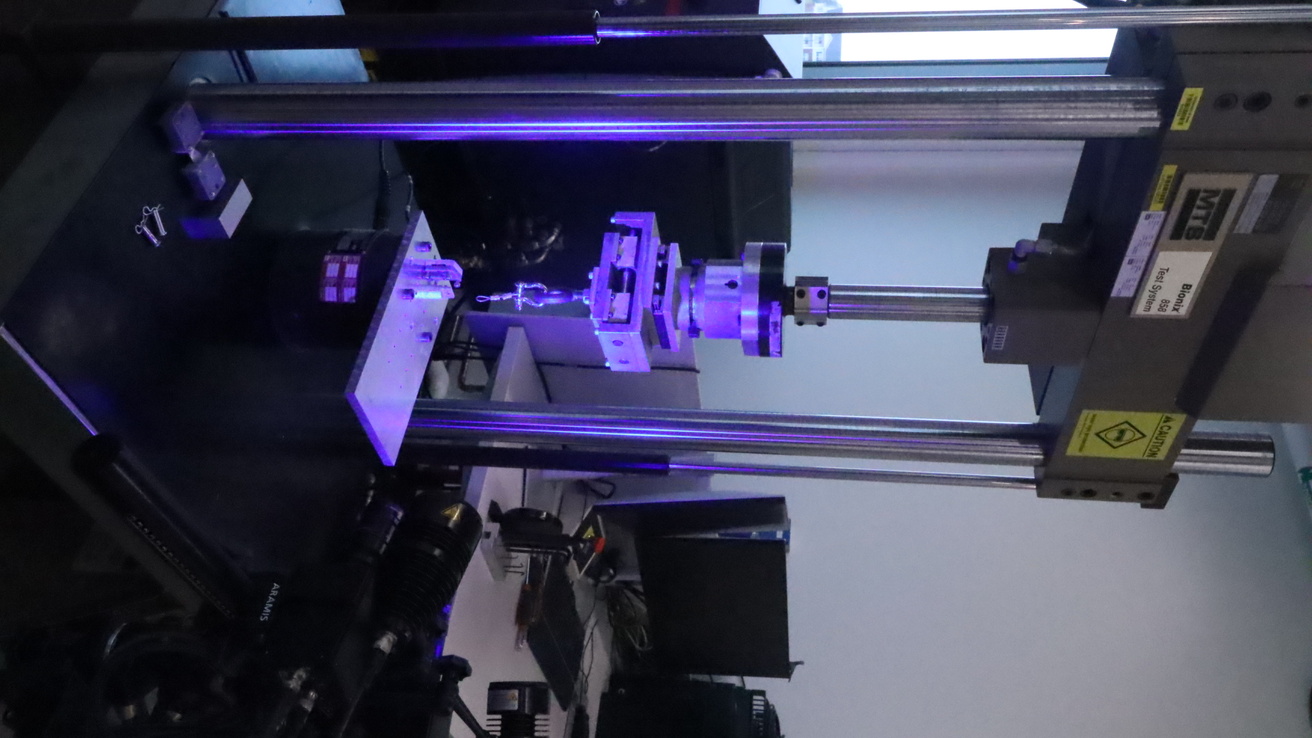
Floor-standing axial/torsional load frame used for macroscopic testing of joints, tissues, and implants.
- Axial capacity: 25 kN
- Torsional capacity: 250 N·m
- Vertical test space: 789 mm (31 in)
- Stroke length: 152.4 mm (6 in)
- Rotational range: ±50°
The system is operated via MTS TestSuite® with graphical user interfaces. Users can configure custom loading protocols ranging from simple steps, ramps, and haversine waveforms to complex physiologic loading histories assembled from concatenated waveform segments. Custom fixturing can be designed and mounted to accommodate a wide range of specimen geometries.
3D Scanner
Add a photo of the 3D scanner alone and potentially the output. Have lots from P4 scans.